#1 Introduction
Your customers are already online.
They're searching Google. They're scrolling Instagram. They're watching YouTube videos. They're comparing brands, reading reviews, checking websites, and asking questions before they ever speak to a salesperson. The real question isn't whether your business needs an online presence. It’s whether your online presence is bringing your business.
That's where professional digital marketing services come in.
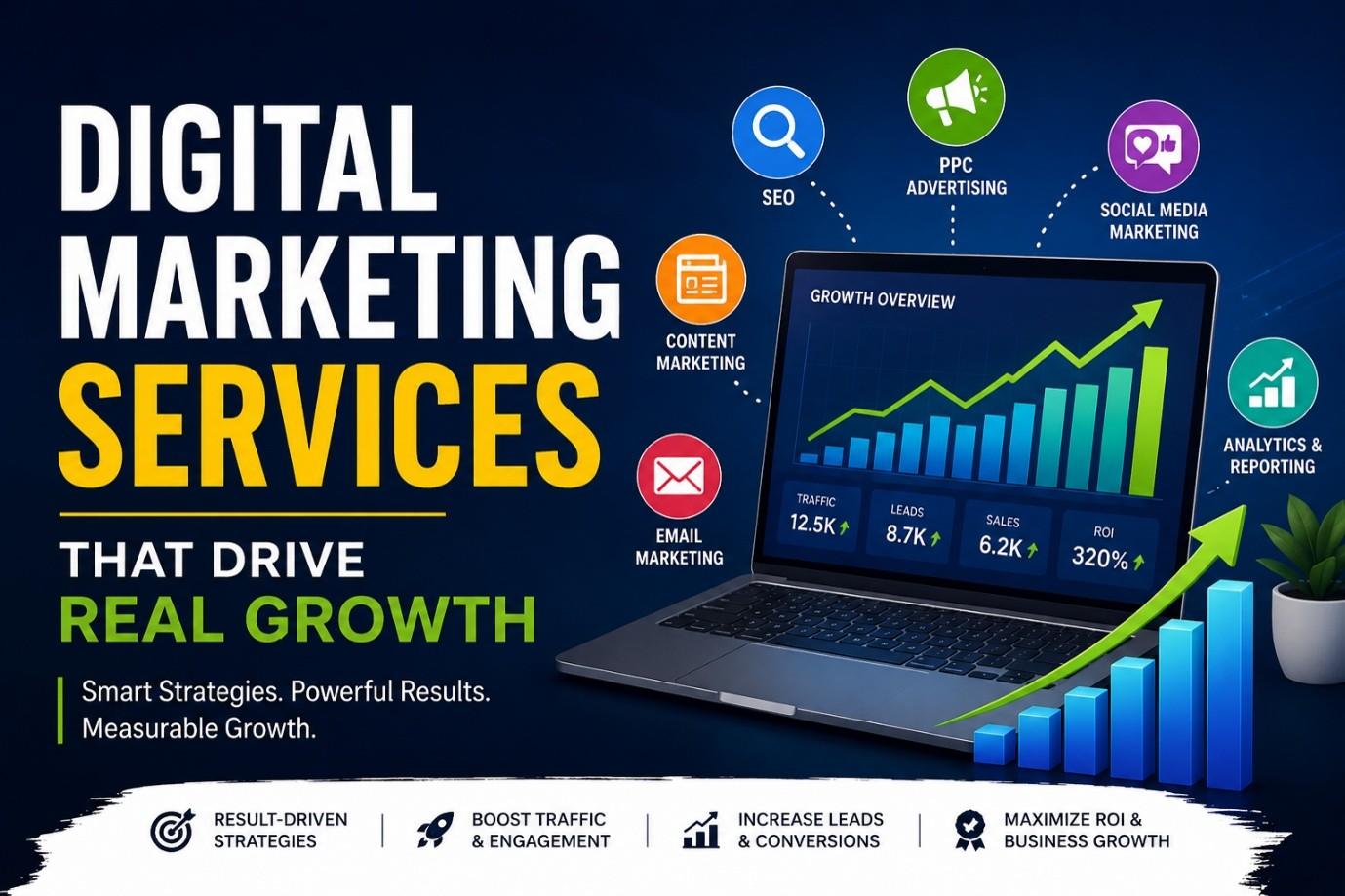
Digital marketing is no longer just about posting on social media or running occasional advertisements. A strong strategy connects search, content, social media, paid advertising, branding, websites, landing pages, and conversion tracking into one system. When those pieces work together, your marketing can do more than generate attention. It can attract the right people, build trust, generate qualified leads, and turn interest into revenue.
This guide explains what digital marketing services include, which ones matter most, how they work together, and what to look for when choosing a digital marketing partner.
#2 What Are Digital Marketing Services?
Digital marketing services are professional strategies and activities designed to help businesses promote their products or services through digital channels.
These channels can include:
The important point is that digital marketing isn't one service. It's an ecosystem.
For example, someone might discover your business through a Google search, visit your website, see your Instagram content later, click a retargeting advertisement, and eventually contact your sales team. If each touchpoint tells the same story, the customer journey becomes much stronger.
Pro Tip: Don't choose marketing channels simply because your competitors use them. Start with your business goal, audience, offer, and customer journey. Then select the channels that support those objectives.
#3 Why Do Businesses Need Digital Marketing Services?
Traditional marketing can still have value, but digital channels give businesses something extremely useful: measurability.
You can often see:
That information gives businesses the opportunity to make smarter decisions.
Google also recommends creating useful, reliable, people-first content rather than producing material primarily to manipulate search rankings. That principle should apply to your entire digital strategy—not just your blog.
A good digital marketing strategy therefore isn't "Let's get more traffic". It's "Let's attract the right people and give them a clear reason to become customers."
What Digital Marketing Services Should a Business Invest In?
There isn't one universal marketing package that works for every business.
- • A local service company may need local SEO, Google Ads, landing pages, and reviews.
- • An e-commerce company may need shopping campaigns, product content, retargeting, email marketing, and conversion optimization.
- • A startup may need positioning, branding, content, paid acquisition, and lead generation.
- • A personal brand may need social media, video content, LinkedIn marketing, and authority-building content.
The strongest strategy is built around the business—not around a predetermined list of services. Here are the major digital marketing services businesses should consider.
#4 1. Search Engine Optimization (SEO)
SEO helps your website become more visible when people search for information, products, or services related to your business. For the fundamentals, Google's SEO Starter Guide is a useful reference for understanding how search engines crawl, index, and understand websites.
A professional SEO strategy can include:
Keyword Research
Finding the searches that matter to your business. The goal isn't to rank for every keyword. The goal is to identify searches that have a realistic connection to your products, services, and customers.
On-Page SEO
This includes improving: Page titles, Headings, Content, Internal links, Images, URLs, Search intent alignment, and Page structure.
Technical SEO
Technical SEO helps search engines crawl, understand, and index your website. It can involve: Crawlability, Indexation, Site architecture, Mobile experience, Page performance, Structured data, and Canonicalization.
Businesses should also follow Google's Search Essentials when building and optimizing their websites.
Off-Page SEO and Link Building
Authority can also be built through relevant external mentions and links. But quality matters more than simply collecting large numbers of backlinks. The goal should be to earn links that make sense for your industry and provide genuine value.
Best for: Long-term organic visibility, high-intent searches, authority, and sustainable traffic.

#5 2. Pay-Per-Click Advertising (PPC)
SEO can take time. Paid advertising can help businesses reach potential customers much faster. PPC advertising includes platforms such as Google Ads and social advertising platforms.
A strong paid campaign involves much more than pressing the "boost" button. It may require:
The real objective isn't simply to get clicks. It's to generate **profitable actions**.
For example, 1,000 clicks + 2 leads may be less valuable than 300 clicks + 25 qualified leads. PPC works best when advertising, landing pages, offers, and tracking are designed as one system.

#7 4. Content Marketing
Content marketing turns your knowledge into an asset. This can include: Blog posts, Guides, Case studies, Videos, Social media content, Newsletters, Downloadable resources, and Educational landing pages.
The best content answers questions customers actually have. This approach also aligns with Google's people-first content guidance, which emphasizes creating useful, reliable content for people rather than content designed primarily to manipulate search rankings.
For example, instead of publishing: "Why Our Company Is the Best", you could publish: "How Much Should a Small Business Spend on Google Ads?" The second topic gives the reader useful information before asking for anything. That approach builds trust.
SEO and content marketing can also reinforce each other: search research can reveal what audiences want to know, while useful content can support organic visibility and authority.
#8 5. Branding and Brand Strategy
Marketing can generate attention. Branding determines what people remember.
Strong branding can include: Brand positioning, Visual identity, Logo design, Typography, Color systems, Brand messaging, Tone of voice, Brand guidelines, and Marketing collateral.
Consider two companies offering similar services. One looks inconsistent across its website and social media. The other has a clear message, polished visual identity, professional content, and consistent positioning. The second company often starts with a trust advantage.
Your brand doesn't have to look expensive. It needs to look intentional.
#9 6. Website and Landing Page Optimization
You can spend thousands on advertising and still struggle to generate leads if your website doesn't convert.
A website should answer three questions quickly:
Effective landing pages often include: A clear headline, Strong value proposition, Relevant benefits, Social proof, Trust signals, Clear calls to action, Simple navigation, Mobile-friendly design, and Conversion-focused copy.
Your website isn't simply an online brochure. It is one of your most important sales assets.

#10 7. Lead Generation
Traffic is useful. Leads are more useful. Lead generation strategies are designed to turn interested visitors into identifiable prospects.
Examples include: Contact forms, Consultation requests, WhatsApp enquiries, Phone calls, Demo bookings, Lead magnets, Newsletter subscriptions, Quote requests, and Free strategy calls.
- • The best lead generation strategy depends on how your customers make buying decisions.
- • A high-ticket service may need consultation calls.
- • A low-cost product may need a simple checkout.
- • A B2B company may need lead magnets and sales qualification.
#11 8. Conversion Rate Optimization (CRO)
Getting visitors to your website is only half the battle. The next question is: How many acts?
Conversion rate optimization, or CRO, focuses on improving the percentage of visitors who complete a desired action. This can involve testing: Headlines, CTA buttons, Forms, Page layouts, Offers, Testimonials, Pricing presentation, Trust signals, and Landing page copy.
Small improvements can matter when a website already receives significant traffic.
#12 How Digital Marketing Services Work Together
The biggest mistake businesses make is treating every marketing channel as a separate activity.
Imagine this journey:
That's a system. Now imagine another:
Digital marketing becomes more powerful when channels support one another:
- • SEO brings organic traffic.
- • Content educates that traffic.
- • Social media increases brand familiarity.
- • Paid advertising accelerates reach.
- • Retargeting brings interested visitors back.
- • Landing pages convert attention into leads.
- • Analytics shows what's working.
This is why simply asking, "Which digital marketing service is best?" isn't always the right question. A better question is: "Which combination of services will help my business reach its next growth goal?"
#13 SEO vs. PPC vs. Social Media
SEO and PPC aren't necessarily competing choices. They can complement each other when used strategically. PPC can provide faster visibility, while SEO can build organic visibility over time.
| Channel | Main Strength | Typical Role | Best For |
|---|---|---|---|
| SEO | Organic visibility | Long-term acquisition | Search-driven businesses |
| PPC | Fast targeted traffic | Lead generation | Immediate demand |
| Social Media | Awareness & engagement | Brand building | Consumer & personal brands |
| Content Marketing | Education & authority | Trust building | Complex products & services |
| Email Marketing | Retention | Customer nurturing | Existing audiences |
| Branding | Differentation | Positioning | New and growing brands |
| CRO | Conversion improvement | Revenue optimization | Businesses with traffic |
#14 How to Choose the Right Digital Marketing Agency
Choosing an agency shouldn't be based only on price. Before signing a contract, ask:
1. Do they understand your business?
An agency should understand: your customers, your competitors, your offer, your sales process, and your business goals.
2. Do they have a clear strategy?
Be cautious if the entire pitch is: "We'll post 20 times per month." Ask what those posts are designed to accomplish.
3. How do they measure success?
Look beyond Likes, Followers, and Impressions. Ask about: Qualified leads, Cost per lead, Conversion rates, Revenue, Search visibility, Customer acquisition, and Return on ad spend.
4. Do they show real work?
Look for Case studies, Campaign examples, Creative examples, Client testimonials, Strategy explanations, and Before-and-after results.
5. Will they communicate clearly?
You shouldn't need a marketing degree to understand your monthly report. A good agency should explain: What happened → Why it happened → What we're changing → What happens next.
#15 Common Digital Marketing Mistakes to Avoid
Mistake 1: Trying Every Platform
Being everywhere isn't the same as being effective. Choose platforms where your audience spends time.
Mistake 2: Chasing Vanity Metrics
10,000 followers mean very little if they never become customers. Measure business outcomes.
Mistake 3: Running Ads Without Tracking
If you can't measure conversions, you can't properly evaluate campaign profitability.
Mistake 4: Ignoring the Website
Sending paid traffic to a confusing website wastes marketing budget.
Mistake 5: Expecting Instant SEO Results
SEO is generally a longer-term channel. Google notes that changes can take anywhere from hours to months to be reflected in Search, depending on the change and circumstances.
Mistake 6: Publishing Content Without a Strategy
More content isn't automatically better. Useful, relevant content is more valuable than publishing simply to hit a content quota.
Mistake 7: Choosing the Cheapest Agency
Low cost can become expensive if the strategy produces poor leads, weak branding, or wasted advertising spend.
#16 How Much Should You Invest in Digital Marketing?
There isn't one universal number. Your investment should depend on:
A business selling a ₹1,000 product and a company selling a ₹10 lakh service shouldn't have the same marketing model. Start with the economics. Ask:
That gives you a much stronger foundation for deciding your marketing budget.
#17 How Long Does Digital Marketing Take to Work?
Different channels operate at different speeds:
Paid Advertising
Campaigns can begin generating traffic quickly, although profitable performance usually requires testing and optimization.
Social Media
Visibility and engagement can grow relatively quickly, but building meaningful brand recognition takes consistency.
SEO
SEO generally requires patience. Rankings can take weeks or months, depending on competition, authority, technical health, content quality, and other factors.
Branding
Brand recognition develops over time through repeated exposure and consistent positioning.
Content Marketing
Individual pieces can sometimes gain traction quickly, but a content library becomes more valuable as useful content accumulates.
The right expectation is not: "When will we go viral?" It's: "Are our marketing assets improving month after month?"
#18 A Practical Digital Marketing Strategy for 2026
A strong strategy can be built in seven steps:
Step 1: Define the Business Goal
Choose a measurable goal. Examples: Generate 50 qualified leads, Increase online sales, Reduce cost per acquisition, Improve organic traffic, Launch a new product, Build brand awareness.
Step 2: Define Your Ideal Customer
Understand: Who they are, What they need, What they fear, What they want, What alternatives they consider, Why they hesitate, What makes them buy.
Step 3: Audit Your Current Marketing
Review: Website, SEO, Social media, Paid campaigns, Content, Branding, Conversion paths, and Analytics. Find the biggest bottleneck.
Businesses should monitor their organic search performance regularly using tools such as Google Search Console rather than relying only on traffic or ranking screenshots.
Step 4: Select Your Core Channels
Don't automatically choose five channels. Choose the two or three that have the strongest connection to your audience and business model.
Step 5: Build the Content and Campaign System
Create: Content pillars, Ad creatives, Landing pages, Offers, CTAs, Campaign structures, and Retargeting audiences.
Step 6: Track Meaningful Metrics
Monitor: Traffic, Leads, Conversion rate, Cost per lead, Customer acquisition cost, Revenue, Return on ad spend, and Organic visibility.
Step 7: Optimize and Scale
Keep what works. Improve what underperforms. Stop what wastes resources. Then increase investment in the strategies producing the strongest business outcomes.
#19 Digital Marketing Services Checklist
Before choosing a digital marketing partner, make sure you can answer "yes" to these questions. Check off the items to calculate your readiness!
#20 Frequently Asked Questions (FAQ)
Conclusion: Ready to Grow Your Business?
Your customers don't experience your marketing as separate departments. They experience one brand. They see your Instagram content, they search your company on Google, they visit your website, they read your content, they see your advertisements, they compare your offer with competitors, and they decide whether they trust you.
That's why modern digital marketing services should work together as a complete customer journey.
If your business is struggling with inconsistent leads, weak online visibility, poor conversion rates, or marketing that feels disconnected, the solution may not be "more marketing." It may be a better strategy.
At G2G Media House, we help businesses bring together content, social media, paid advertising, branding, websites and funnels, and SEO with a growth-focused approach.
If your goal is to attract more of the right customers—not simply generate more online activity—the next step is to identify what's currently preventing your marketing from converting. Start with the bottleneck. Fix the system. Then scale what works.
Get In Touch Today for a Consultation
Discover how data-driven digital marketing can help your business grow with confidence. Let's build a strategy that works for you.
#6 3. Social Media Marketing
Social media can help businesses become visible, recognizable, and trusted. But posting randomly isn't a strategy.
Effective social media marketing usually starts with:
Content might include: Reels, Carousels, Static graphics, Educational posts, Customer stories, Testimonials, Behind-the-scenes content, Founder content, UGC, and Promotional campaigns.
The goal isn't to make every post go viral. The goal is to repeatedly give the right audience a reason to remember your brand.