Imagine you have a great website, a strong service and an offer your customers genuinely need. But when someone searches Google for that service, they don't find you.
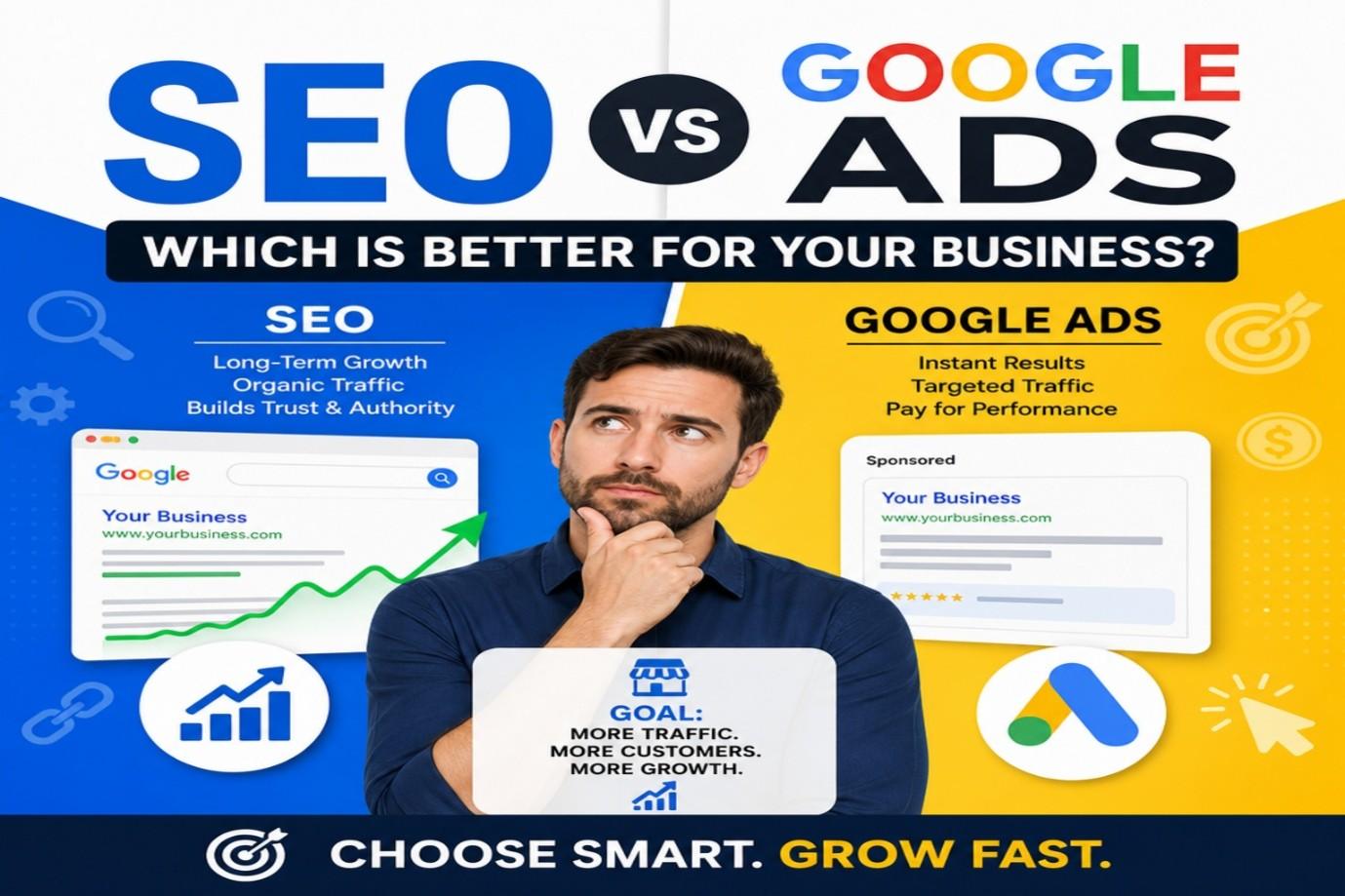
Should you invest in SEO or Google Ads?
It's an important decision because both channels can put your business in front of people who are actively searching. But they work in very different ways.
SEO helps you build visibility in Google's organic search results. Google Ads lets you pay for advertising placements and reach relevant searchers much faster.
The honest answer is: it depends on your business, goals, budget, competition and timeline. And in many cases, the smartest strategy isn't choosing one—it's using SEO and Google Ads together.
SEO vs Google Ads: What's the Difference?
The Simplest Difference:
SEO earns search visibility. Google Ads buys search visibility.
| Factor | SEO | Google Ads |
|---|---|---|
| Traffic type | Organic | Paid |
| Direct cost per click | No direct CPC | Yes (PPC model) |
| Speed | Usually slower (compounding) | Immediate visibility |
| Long-term value | High potential asset | Depends on continued spend |
| Control | Moderate | High control |
| Traffic when budget stops | Continues ranking | Stops immediately |
What Is SEO?
SEO stands for Search Engine Optimization. If you're looking to build sustainable organic visibility, professional SEO services can help create a structured strategy around technical SEO, content, keywords and authority.
According to the Google SEO Starter Guide, search engines prioritize unique, well-organized and people-first content.
SEO Advantages & Limitations
• Long-term organic compounding visibility
• Builds hundreds of entry points for searches
• Reduces dependence on rising ad costs
• Continues generating traffic after publish
• Takes weeks or months to build traction
• High competition in lucrative niches
• Requires continuous content and technical upkeep
What Are Google Ads?
Google Ads is Google's paid advertising platform. Businesses that need faster visibility can consider professional Google Ads management with conversion tracking and ongoing campaign optimization.
Google Ads Advantages & Limitations
• Rapid visibility and instant lead opportunities
• Precise keyword, geo, and demographic targeting
• Rapid experimentation with ad copy & offers
• Captures immediate high-intent emergency searches
• You pay for every click
• High competition drives up cost-per-click
• Traffic stops the moment ad budget runs out
SEO vs Google Ads: Side-by-Side Comparison
Read the comprehensive Ahrefs SEO vs PPC Guide to examine data-driven search trends.

| Business Factor | SEO | Google Ads |
|---|---|---|
| Initial speed | Slow to moderate | Fast |
| Long-term potential | Excellent | Moderate |
| Immediate leads | Limited initially | Strong potential |
| Budget control | Indirect | Direct |
| Cost per click | No direct CPC | Yes |
| Testing speed | Moderate | Fast |
| Sustainable traffic | Potentially years | Requires ongoing spend |
| Best for new offers | Limited | Excellent |
| Best for evergreen demand | Excellent | Excellent |
| Conversion optimization | Important | Critical |
SEO vs Google Ads: Which Is More Cost-Effective?
Business A spends ₹50k on SEO and gets 30 leads. Business B spends ₹50k on Google Ads and gets 40 leads. But Business A continues receiving organic leads month after month without paying per click. Measure Customer Acquisition Cost + Customer Value + Revenue, not simply initial clicks.
Which Gives Results Faster?
Think of it like this:
Google Ads = Accelerator. SEO = Engine. The accelerator gets you moving quickly; the engine sustains the journey.
Which Generates Better Leads?
Lead quality depends on search intent and your conversion optimization system. A campaign producing 200 clicks and 30 qualified leads beats 1,000 broad clicks and 5 low-intent leads.
Should You Use SEO and Google Ads Together?
Ahrefs' analysis of 2.3 million keywords found that 37.9% of advertised websites already ranked in Google's top 10 organically. Using both creates total search dominance.
• Month 1: Launch Google Ads for immediate enquiries while starting SEO foundational audit.
• Month 3: Identify the most profitable paid keywords and prioritize them in your SEO content cluster.
• Month 6: Organic rankings take off; shift PPC budget to high-intent commercial keywords.
• Month 12: Compound multi-channel dominance with organic + paid search equity.
A Simple 5-Question Decision Framework
Answer these 5 quick questions to see which search strategy fits your current stage:
1. Do I need leads & customers immediately this month?
2. Do customers regularly search for my services on Google?
3. Is my customer lifetime value high enough to support paid CPC?
4. Can our business wait 3–6 months to compound organic rankings?
5. Can our business afford to build both channels together?
Final Verdict: SEO vs Google Ads
The Winner:
Use Google Ads for speed. Use SEO for sustainable growth. Use both when the economics make sense.
For complete campaign integration, explore our full suite of digital marketing services.
Ready to Turn Google Searches Into Customers?
You don't need to guess whether SEO or Google Ads is right for your business. G2G Media House can help you evaluate your search demand, competition, and growth targets.